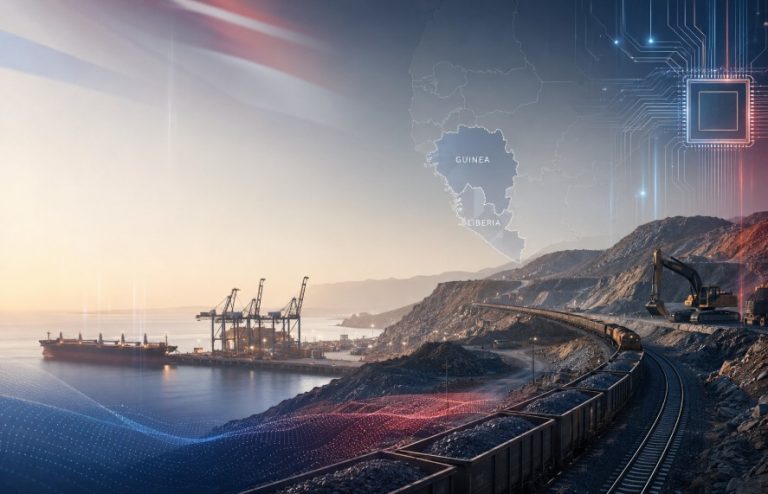
Liberia’s rapid expansion in iron ore exports is emerging as a meaningful new driver of capesize demand in 2026, according to Braemar analysis. While West African bulk growth discussions have largely focused on Guinea and Simandou, Liberia has sharply increased shipments — from an average 4.2m tonnes annually in 2020–24 to nearly 10m tonnes last year — as ArcelorMittal ramps up its new concentrator.
Crucially, rail and port upgrades at Port of Buchanan now allow regular capesize and even newcastlemax loadings, replacing the draft-restricted supramax and ultramax trades that previously dominated. Vessel tracking in H2 2025 already shows capesize shipments, mainly to China.
With ArcelorMittal targeting 18m tonnes in 2026 — and government projections as high as 25–30m tonnes once additional mines restart — Liberia could materially increase long-haul tonne-mile demand. Though smaller than Guinea’s potential, Braemar sees the expansion as strategically significant, creating a complementary West Africa–Asia/Europe capesize corridor and new employment options for large bulkers in 2026.
Liberia’s scale will not rival Guinea’s full Simandou potential. However, its strategic relevance lies in diversification. For capesize owners and operators, Liberia introduces an additional West African loading origin capable of supporting sustained, large-parcel shipments.
This development creates a complementary export corridor from West Africa to both Asia and Europe. It broadens routing choices, enhances triangulation possibilities, and may help balance ballast patterns in the Atlantic basin. As larger vessels displace supramax and ultramax units on key loadings, fleet deployment dynamics in the region could gradually recalibrate.
In effect, Liberia is transitioning from a marginal iron ore exporter into a structurally relevant capesize supplier. For a segment that remains highly sensitive to incremental tonne-mile growth, that shift matters.