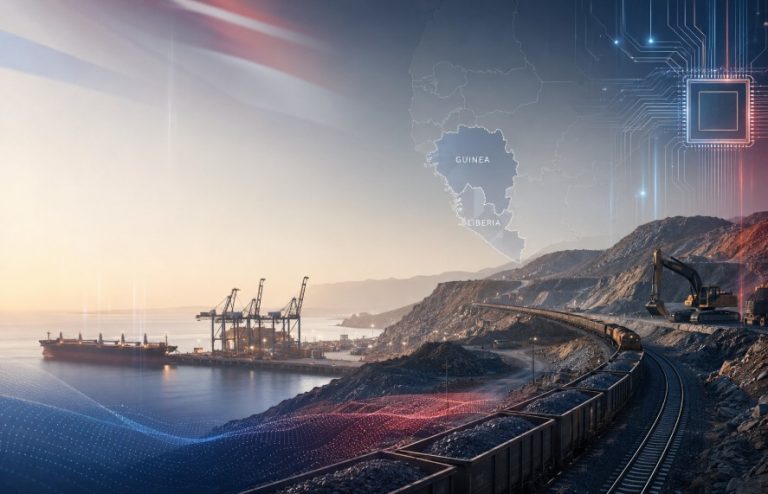
Liberia’s decision to advance the Putu Iron Ore Project under a new, Liberian-led consortium marks a potentially significant evolution in the country’s approach to resource development—moving from concession-based extraction toward integrated, ownership-driven industrialization.
Long regarded as one of Liberia’s most promising but underdeveloped mineral assets, Putu is now being repositioned not merely as a mining project, but as a test case for a new economic model—one that seeks to capture greater in-country value while addressing long-standing infrastructure deficits.
From Extraction to Integration: A New Operating Model
Historically, Liberia’s mining sector has followed a linear export model: foreign-led investment, limited domestic participation, and infrastructure designed primarily for single-operator use. While effective in generating revenues, this approach has constrained broader economic spillovers.
The Putu project introduces a different architecture.
Developed through Africa Metallic Resources Inc. (AMR), a Liberian-led special purpose vehicle, the project brings together:
- Regional development capital through the Africa Finance Corporation (AFC)
- আন্তর্জাতিক engineering and infrastructure expertise via private sector partners such as Conex Group
- Domestic ownership and participation as a central structuring principle
This alignment reflects a deliberate shift toward integrated project delivery—where financing, infrastructure, and operations are coordinated from inception.
The Infrastructure Challenge—and Opportunity
Putu’s defining constraint has historically been its location. Situated in Liberia’s southeastern corridor, the deposit lies outside existing rail and port networks, requiring greenfield investment in logistics, power, and transport infrastructure.
Previous operators struggled not due to resource quality, but due to the scale and complexity of these enabling investments.
The current model reframes this constraint as an opportunity: positioning infrastructure development not as a cost center, but as a parallel value driver. In effect, Putu is being conceived as a “corridor project”—with mining as the anchor, but broader economic connectivity as the outcome.
Economic Potential: High Impact, High Execution Risk
Projected returns are material:
- $1.5–$2.0 billion in export revenues
- Up to $200 million annually in government income
- More than 20,000 jobs across the project lifecycle
However, these projections must be weighed against execution realities. Large-scale, infrastructure-heavy mining projects in frontier markets carry elevated risks—particularly around financing, timelines, and coordination across multiple stakeholders.
Putu’s track record underscores this: ambition alone has historically proven insufficient without aligned capital, governance, and delivery capacity.
Strategic Alignment: Resource Nationalism Meets Industrial Policy
The project aligns with a broader policy shift in Liberia toward:
- Increased local ownership and participation
- Multi-user, open-access infrastructure models
- Downstream value addition and industrialization
In this context, Putu serves as more than a standalone investment—it is a proving ground for whether Liberia can transition from a host of extractive activity to an active architect of its resource economy.
Investor Implications: A New Template Emerging
For investors, the Putu model highlights several structural trends:
- Integrated project development is becoming essential in infrastructure-constrained environments
- Development finance institutions (DFIs) are playing a catalytic role in de-risking large-scale assets
- Local participation frameworks are increasingly central to securing political and social license
- Corridor-based strategies may unlock previously stranded resources
If successful, this approach could redefine how mining investments are structured in Liberia—and potentially across similar frontier markets.
Outlook
Putu represents both opportunity and test.
Its success would not only unlock a major iron ore asset, but also validate a more balanced, locally anchored model of resource development—one that integrates infrastructure, financing, and national participation.
Its failure, however, would reinforce long-standing concerns around execution risk in complex, capital-intensive projects.
Either way, the project stands as a bellwether for the next phase of Liberia’s mining sector—and a signal of how the country intends to negotiate its place in the global commodities landscape.