Another train collision. Another disrupted rail corridor. Another round of questions about communication systems, operational oversight, and safety standards along Liberia’s most important mining railway.
But focusing solely on the latest ArcelorMittal Liberia rail accident risks missing the bigger story.
The real issue is governance.
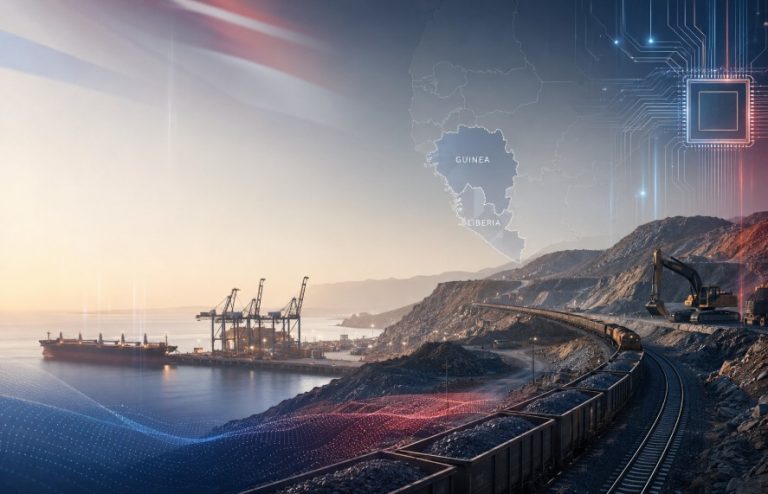
The Yekepa-Buchanan railway is not simply a logistics corridor serving a mining company. It is one of Liberia’s most strategically important infrastructure assets. It connects inland mineral wealth to international markets, supports export activity, and has the potential to serve multiple industries and users far beyond a single concession.
Yet despite its national importance, the railway continues to operate within a governance framework that many believe remains heavily influenced by the interests of its primary user.
That concern has become increasingly difficult to ignore.
The latest collision near Gbadin Camp #3 follows a history of derailments, accidents, operational disruptions, and safety concerns that have periodically raised questions about how the corridor is managed. While investigations will determine the immediate cause of this incident, repeated accidents inevitably shift attention away from individual mistakes and toward the strength of the system itself.
When similar incidents occur repeatedly, stakeholders begin asking whether the problem is operational—or structural.
That question becomes even more relevant when viewed against the backdrop of the Third Amendment to ArcelorMittal Liberia’s Mineral Development Agreement.
For roughly US$200 million in commitments and associated investments, Liberia effectively extended strategic influence over a national rail asset that could shape the country’s economic future for decades. Supporters viewed the agreement as necessary to secure investment and expand mining operations. Critics argued that the country may have undervalued a long-term infrastructure asset whose future earning potential extends far beyond a single operator.
The debate remains unresolved.
But every new rail incident adds fresh urgency to the conversation.
Because the railway’s value is not measured solely by the iron ore it carries today. Its value lies in what it could support tomorrow.
A properly governed multi-user rail corridor could facilitate additional mining projects, agricultural exports, industrial development, logistics services, and broader economic integration. It could become a national platform for growth rather than simply a conduit for resource extraction.
That possibility depends on governance.
This is where the establishment of the National Rail Authority represents an important development.
The decision acknowledged a principle that many successful resource economies have already embraced: strategic infrastructure should ultimately be governed in the national interest, with independent oversight mechanisms capable of balancing commercial efficiency with public accountability.
Creating the institution, however, is only the beginning.
Effective rail governance requires more than legal frameworks. It requires technical expertise, regulatory authority, transparent reporting systems, safety oversight, operational auditing, and the ability to investigate incidents independently. Most importantly, it requires the institutional confidence to ensure that national infrastructure serves broader economic objectives rather than the priorities of any single stakeholder.
This is not an argument against private investment.
Liberia needs investment. It needs mining. It needs infrastructure development. Companies willing to deploy significant capital into complex operating environments play a critical role in economic growth.
But strong investment environments and strong governance environments are not mutually exclusive.
In fact, they often reinforce one another.
Independent oversight can improve safety. Clear operating standards can reduce risk. Transparent governance can increase investor confidence. Reliable infrastructure can support broader economic participation. These outcomes benefit countries and investors alike.
The challenge for Liberia is ensuring that governance evolves alongside infrastructure.
The country’s economic ambitions increasingly extend beyond individual concession agreements. Policymakers frequently speak about industrialization, regional trade integration, export diversification, and long-term competitiveness. Achieving those objectives will require institutions capable of managing national assets through a wider economic lens.
The railway is one of those assets.
And that is why the latest collision matters.
Not because accidents alone define the future of a rail corridor, but because repeated incidents force difficult questions about whether existing governance structures are sufficient for the future Liberia hopes to build.
The country now stands at an important juncture.
The National Rail Authority can remain a promising concept, or it can become a fully empowered institution capable of shaping the future of rail governance in Liberia. The difference will be determined by legislation, implementation, technical capacity, and political commitment.
What is clear is that the conversation can no longer be limited to damaged locomotives and disrupted operations.
The railway carries more than iron ore.
It carries investment, trade, industrial opportunity, and the possibility of a more connected Liberian economy.
How that asset is governed may ultimately prove far more important than any single accident along the line.