A $1.8 billion, U.S.-aligned iron ore venture is advancing toward production in West Africa, as Ivanhoe Atlantic secures a critical regulatory approval in Liberia—sharpening its position within an increasingly competitive and geopolitically sensitive minerals landscape.
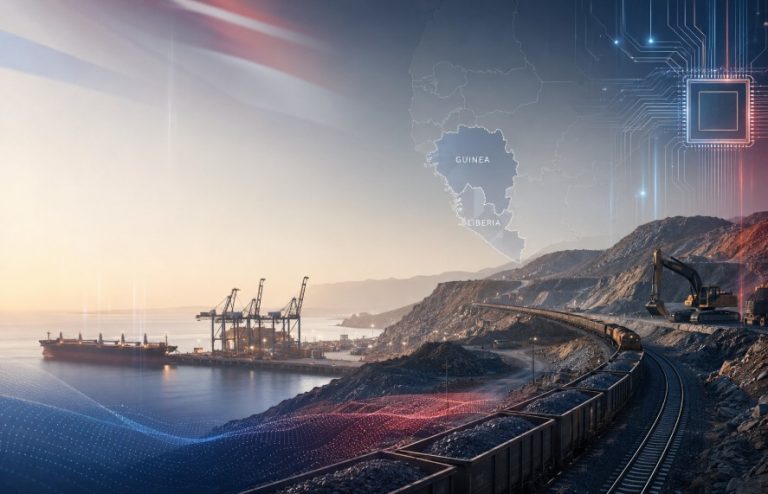
The company’s Kon Kweni project, a high-grade deposit in Guinea, has received formal clearance of its Environmental and Social Impact Assessment (ESIA) from the Liberian government. The milestone unlocks Phase One development, centered on transport and logistics infrastructure linking Guinea’s ore to export markets via Liberia’s rail network and the Port of Buchanan.
At the core of the investment is the “Liberty Corridor,” a strategic route designed to channel iron ore through a Western-aligned supply chain. With projected output scaling from 2–5 million tonnes annually to as much as 30 million, the նախագ positions itself as a credible alternative to China-backed infrastructure dominating the region—most notably the Simandou corridor.
The approval builds on the 2025 ratification of Ivanhoe Atlantic’s concession agreement, granting access to Liberia’s rail and port systems under a multi-user framework. For investors, this signals both regulatory traction and a broader shift toward shared infrastructure models aimed at unlocking regional resource flows.
Beyond scale, the project carries significant economic implications: infrastructure upgrades, logistics expansion, and long-term value creation across the corridor. It also reinforces Liberia’s emerging role as a strategic transit hub in cross-border mining and trade.
However, the development unfolds amid heightened geopolitical scrutiny. U.S. concerns over potential Chinese linkages—firmly denied by the company—underscore the growing importance of supply chain alignment in critical minerals. Ivanhoe Atlantic has positioned the project explicitly within U.S.-aligned trade routes, targeting markets outside China.
The milestone also coincides with a leadership transition, as Executive Chairman J. Peter Pham steps in as interim CEO following the recent departure of the company’s chief executive—introducing a new phase of oversight at a pivotal moment.
With regulatory momentum building and strategic positioning taking shape, the Kon Kweni project is evolving into more than a mining investment. It is a test case for how infrastructure, geopolitics, and capital converge to redefine control over the next generation of global resource supply.