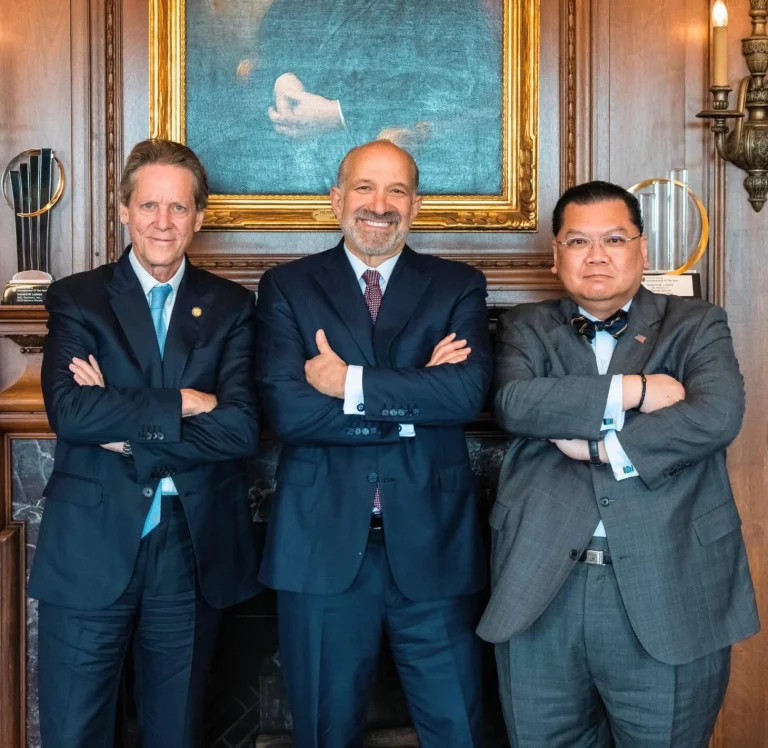
The return of the American Business Association in Liberia is easy to frame as an organizational development.
It is more consequential than that.
ABAIL’s reconstitution comes as Liberia is trying to attract capital across mining, infrastructure, energy, agriculture, technology and services while simultaneously addressing the institutional weaknesses that have historically constrained private investment.
That makes the timing significant.
The association’s newly installed leadership, headed by President Abraham Avi Zaidenberg, inherits an opportunity that extends beyond representing American-linked businesses. It can become an intermediary between investors and government at a time when both sides have a shared interest in making Liberia a more predictable place to do business.
That will require more than networking.
The message from Finance and Development Planning Minister Augustine Kpehe Ngafuan was revealing. Government, he argued, cannot deliver economic transformation alone. Public institutions require private capital, technical capacity and commercial discipline; investors, in turn, require credible institutions, transparent rules and a policy environment in which long-term decisions can be made with reasonable confidence.
That is the basis of a functioning investment ecosystem.
It is also where ABAIL can become useful.
Foreign investors rarely need another forum in which to describe their challenges. They need mechanisms through which those challenges can be aggregated, prioritized and addressed.
The U.S. Embassy’s engagement with American and American-linked companies appears to have identified a consistent set of concerns: procurement transparency, coordination across government agencies, land administration and digital infrastructure, alongside broader sector-specific opportunities.
These are not cosmetic issues.
They go directly to the cost of doing business.
Unclear land records can delay projects. Poor inter-agency coordination can lengthen approvals. Weak digital systems increase administrative friction. Opaque procurement can discourage credible bidders. Each problem may appear modest in isolation; collectively, they influence whether capital moves into a market or waits elsewhere.
This is where business associations can matter.
At their best, they reduce the distance between the private sector and the state. They give investors a collective voice while giving government access to information that individual companies may be reluctant to raise publicly.
The risk, however, is that such institutions become chambers of conversation rather than engines of reform.
ABAIL’s credibility will therefore depend on whether it can move from advocacy to evidence.
That means identifying recurring business constraints, documenting them, engaging the relevant agencies and tracking whether reforms actually occur.
The association’s proposed role as a bridge is appropriate—but bridges are measured by what crosses them.
For Liberia, the broader economic stakes are considerable.
Minister Ngafuan’s comments on public-private partnerships, domestic processing and regional trade reflect a policy ambition that is larger than attracting individual projects. Liberia is attempting to build productive capacity: infrastructure that unlocks investment, businesses that can participate in supply chains, and industries capable of processing more of what the country currently exports in raw form.
That agenda requires both foreign and domestic capital.
American businesses have an obvious role to play, but the relationship should not be viewed as one-directional. Liberia needs investment; investors need a market in which capital can operate efficiently. The strongest partnerships are therefore those in which commercial interests and national development priorities reinforce rather than compete with each other.
ABAIL can help create that alignment.
Its membership can bring capital, expertise, technology, management capability and international commercial networks. Liberia, in turn, can offer access to a market with substantial untapped potential across natural resources, logistics, agriculture, energy and emerging industries.
The opportunity is real.
So is the work required to capture it.
The association has already articulated an ambitious mandate around trade, investment, workforce development, responsible business and policy dialogue. The challenge will be maintaining institutional discipline as that agenda expands.
ABAIL should resist becoming another organization that produces statements when what the market needs is follow-through.
Its most valuable contribution may ultimately be less visible: helping government understand where investors are encountering friction, helping businesses understand how policy is evolving, and creating a credible channel through which both sides can resolve practical problems.
That is a useful role in any economy.
In Liberia, it could become an important one.
The association has been given a second start.
Its success should not be measured by the prominence of its launch, the size of its membership or the number of meetings it holds.
It should be measured by whether a business finds it easier to invest, whether a local company finds it easier to participate, and whether government becomes more responsive to the realities of operating in Liberia.
ABAIL is back.
The real question is what it can change.